Why is Sacred Heart being redeveloped?
The Sacred Heart Church is a Roman Catholic Church in East Cambridge, MA that was built in 1870s and 1880s to serve the parish first organized as the St. John the Evangelist Parish. The Church cornerstone was laid in 1874 and the Church opened for service in 1876. The rectory was built in 1885, and the convent and school followed in 1902. The Church was designed in a Gothic Revival style by Peter Paul Pugin and Patrick W. Ford, two eminent 19th-century church architects. The Parish School opened in 1902 and was staffed by the Sisters of St. Joseph. In the 1960s, the School closed and became the administrative offices of Cambridge Public Schools. With its historic significance, the entire complex was listed as a landmark on the National Register of Historic Places in 1982.

Since the late 20th century, the School, Convent, and Rectory sat vacant and underutilized, while the surrounding community of East Cambridge was facing redevelopment pressures by market rate developers. The redevelopment proposal for preserving the historic buildings and converting them into affordable housing is well received by neighbors and local officials.
What will the construction scope consist of?
Redevelopment of the Sacred Heart complex will involve the following work:
- Structural Rehabilitation: Extensive efforts will be dedicated to structural improvements, like rebuilding and repairing the foundation, improving internal structures like walls and roofing, and repairing additional structural elements to adapt for residential use.
- Mechanical, Electrical, and Plumbing (MEP) Renovation: New all-electric MEP systems will be retrofitted into the building, providing energy efficiency and eliminating the consumption of any fossil fuels.
- Historical Restoration: The redevelopment will restore the majority of historical elements of the School, Convent, and Rectory buildings. Wooden floors will be retained and refinished to the extent salvageable. All windows will be replaced with aluminum-clad wooden windows throughout the property with trim matching the existing colors, and historic doors will be refinished with new stain and hardware. Much of the wall trim, including wainscoting, chair rails, and other trim surrounding doors and windows, will be refinished. Other historical features like stained glass windows and staircase railings will be preserved and restored. All historic fireplaces will remain and made dysfunctional. The exterior brick masonry will undergo extensive restoration and repointing. The existing slate roofing will be replaced with composite slate roofing that matches the historic condition.
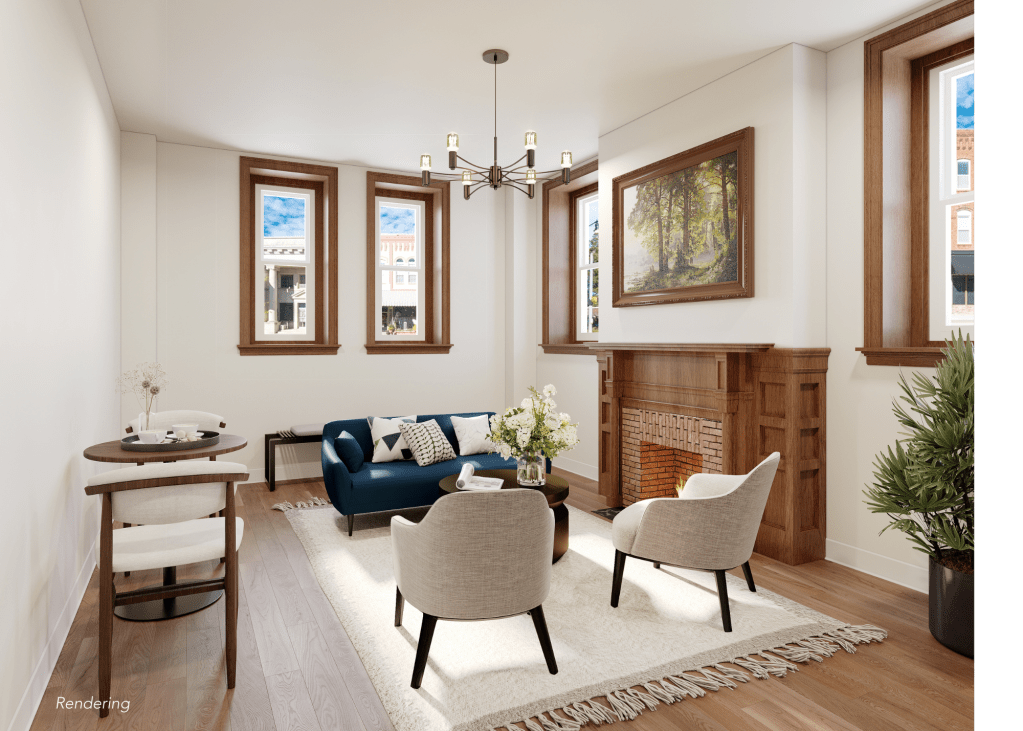
- Interior Construction: The creation of modern apartments will require a significant transformation of the interior by installing walls, partitions, flooring, and fixtures, and integration of modern utilities.
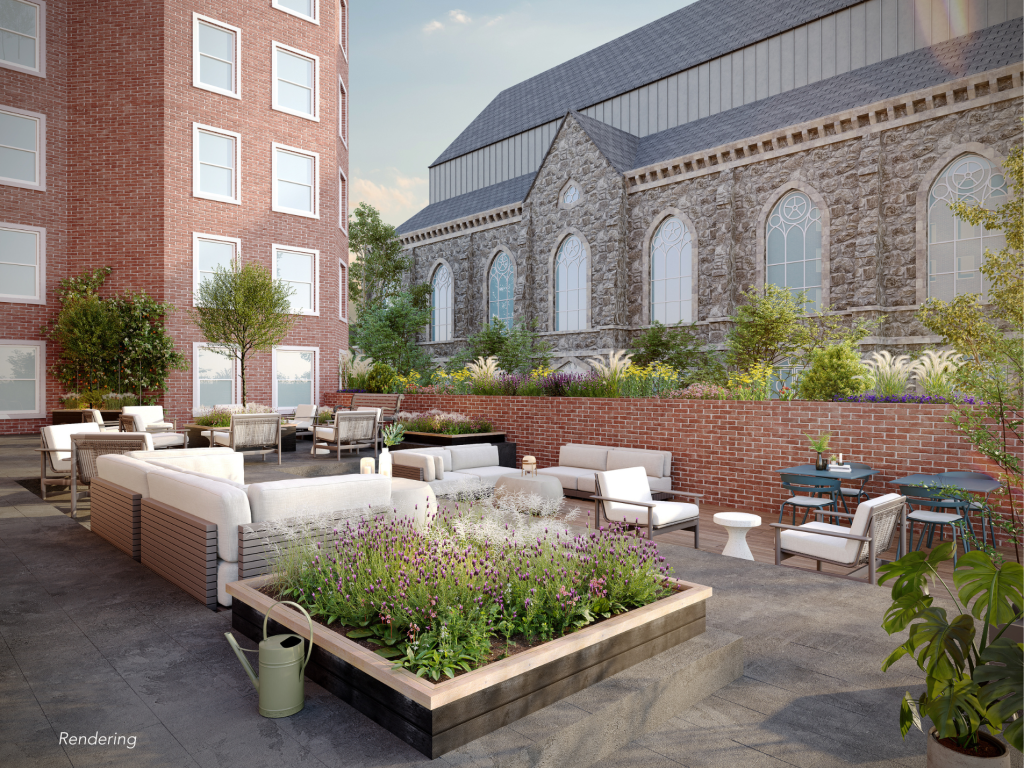
- Common Areas and Amenities: In addition to the 46 apartments, new amenities will be built for future residents, including a lobby and mail room, resident lounges on each floor, a bike parking facility, common laundry, a landscaped common courtyard, and a pocket park.
What is the construction timeline?
Construction will begin in June 2025 and finish in the fall of 2027. The first year of construction in 2025 will consist of interior selective demolition and abatement of the existing materials. In 2026, the work will become more extensive, with structural and interior improvements. Construction is expected to be completed by the fall of 2027, with the first residents able to move in by December 2027.
The estimated project duration of 29 months reflects the complexity of the construction scope. This timeline allows for detailed planning and meticulous execution to ensure the successful transformation of the church campus into residences. Due to the historic age of the buildings, it will take over eight months to salvage historic materials, demolish components that are not worth saving, excavate and protect the ground floor, and set up the complex for structural improvements. Once the team begins actual construction work, the dense urban neighborhood of East Cambridge will restrict space for loading and speed of deliveries.
Who can live in the new apartments?
The 46 homes will be available to a range of households, ranging from those earning less than 30% of the Area Median Income (AMI) to those earning up to 80% of AMI. Although the number of apartments and their income restrictions are subject to change depending on input received from the City of Cambridge and the Commonwealth of Massachusetts, the table below provides a preliminary breakdown of unit affordability and the approximate range of maximum incomes that qualify for these units. Please keep in mind that the figures below represent the top of the range for a particular household size. In other words, to move into a 50% AMI one-bedroom apartment, a 1-person household could earn up to $57,900; a 2-person household within that same AMI bracket could earn up to $66,200. The Maximum Incomes are calculated per household size and income bracket.
| Unit Target Income | Units | Range of Maximum Incomes (1-person – 4-person household) |
| 30% AMI | 8 | $34,750 – $49,600 |
| 50% AMI | 8 | $57,900 – $82,700 |
| 60% AMI | 24 | $56,000 – $81,000 |
| 80% AMI | 6 | $92,650 – $107,000 |
The apartments will be leased through a lottery system administered by our management company, POAH Communities.
Will off-street parking be included at the property?
No new off-street parking spaces will be created as part of the project. Cambridge’s Affordable Housing Overlay, a special zoning district that the City enabled in 2019, helps to create new affordable housing in Cambridge by providing a more efficient zoning process for fully affordable housing developments. One of the efficiencies provided is a waiver of the requirement for off-street parking. However, we are sympathetic to neighborhood concerns about traffic, and we are exploring ways to minimize the effects of traffic, including a designated pick-up and drop-off zone, ample bicycle storage, and financial incentives for residents who use public transportation. The property is located within a 10-minute walk of the Lechmere Green Line T station and a 15-minute walk to the Kendall Square Red Line T station.
 The Rose on Sixth Street